Domain Authority vs Domain Rating - DA vs DR Compared
Domain Authority (Moz DA) vs Domain Rating (Ahrefs DR) — complete comparison of how each is calculated, their differences, score ranges, and which metric you should use for SEO analysis.
Domain Authority vs Domain Rating: Overview
Domain Authority (DA) and Domain Rating (DR) are the two most popular metrics for measuring a website's authority and ranking potential. But they come from different companies, use different data, and can give very different results for the same website. To understand DA in depth, see our complete guide to Domain Authority and Page Authority.
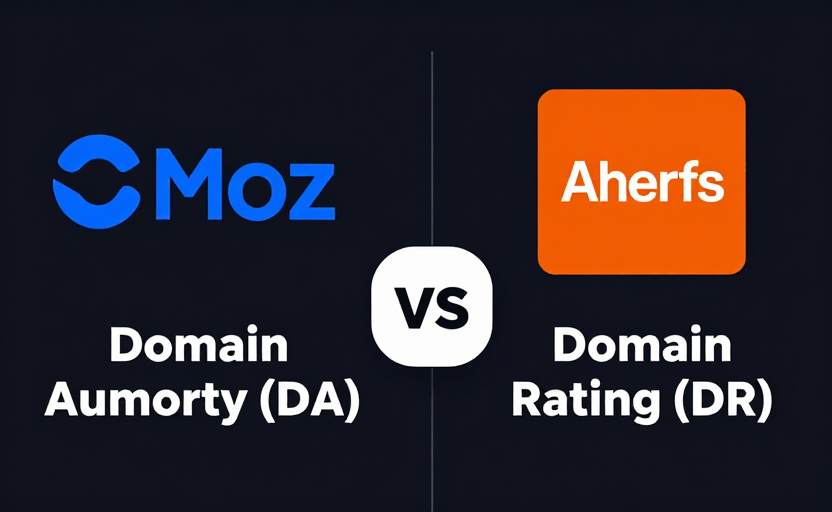
| Feature | Domain Authority (DA) | Domain Rating (DR) |
|---|---|---|
| Developer | Moz | Ahrefs |
| Scale | 1-100 | 0-100 |
| Data source | Moz link index | Ahrefs link index |
| Primary focus | Overall ranking potential | Backlink profile strength |
| Free tool | Moz Link Explorer | Ahrefs DR Checker |
| Update frequency | Every 3-4 weeks | More frequent |
Check both metrics now using our free DA PA Checker and Domain Rating Checker tools.
What is Domain Authority (Moz DA)?
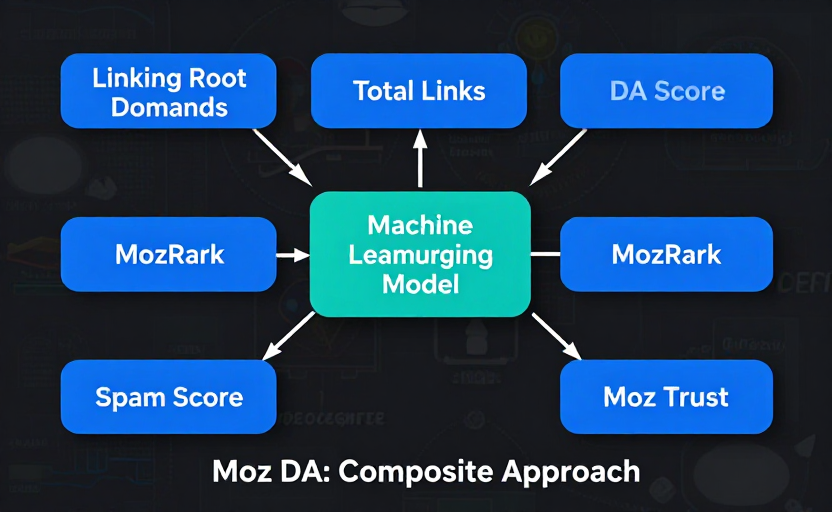
Domain Authority is Moz's prediction of how well a website will rank on search engines. It's calculated using a machine learning model that considers multiple link metrics:
- Linking root domains — Number of unique domains linking to the site
- Total links — Overall number of backlinks
- MozRank — Link equity passed by links
- MozTrust — Trustworthiness of linking sites
- Spam Score — Negative signals from the link profile
DA is a composite metric that tries to predict ranking potential by combining multiple signals. It's designed to answer the question: "How well will this site rank overall?"
What is Domain Rating (Ahrefs DR)?
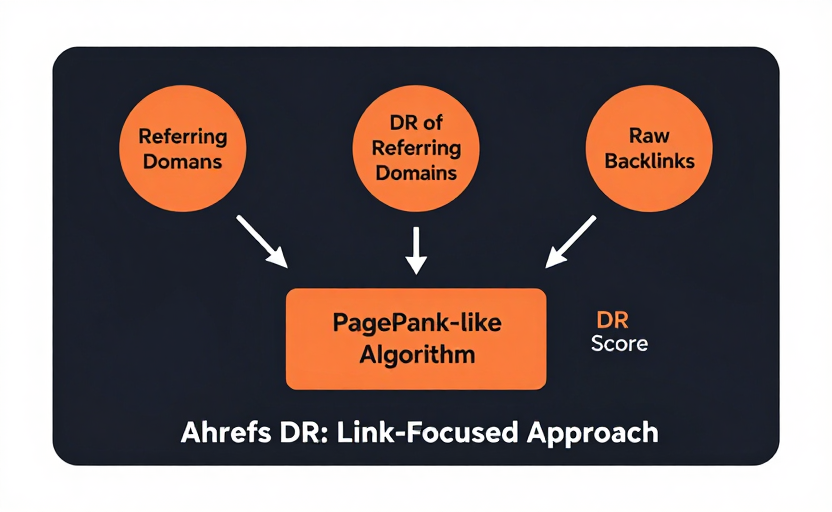
Domain Rating is Ahrefs' measure of a website's backlink profile strength. It's calculated using a simpler, more focused approach:
- Referring domains — Number of unique domains linking to the site
- DR of referring domains — Links from high-DR sites pass more "DR juice"
- Raw number of backlinks — Total link count (less important than referring domains)
DR is a link-focused metric that works like PageRank for domains. It's designed to answer the question: "How strong is this site's backlink profile?"
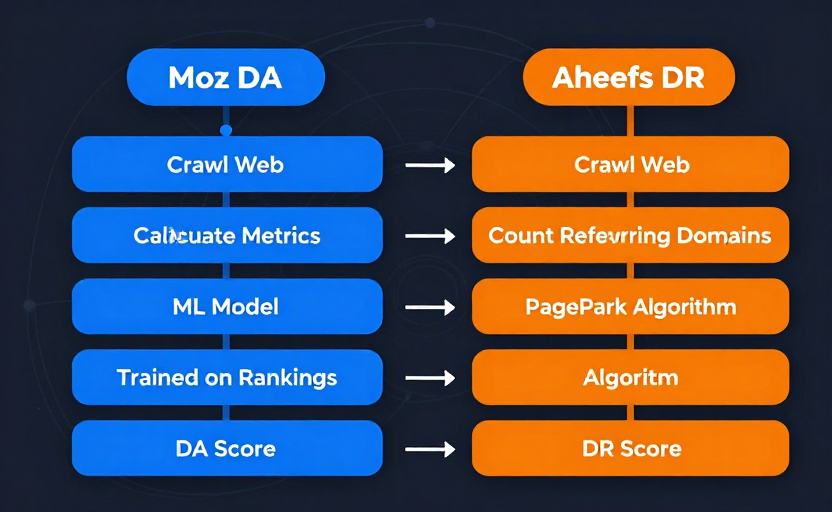
How DA is Calculated vs How DR is Calculated
DA Calculation (Moz)
- Moz crawls the web and builds their link index
- Multiple link metrics are calculated (MozRank, MozTrust, etc.)
- A machine learning model combines these metrics
- The model is trained against actual Google rankings
- DA is scored on a 1-100 logarithmic scale
DR Calculation (Ahrefs)
- Ahrefs crawls the web and builds their link index
- They count referring domains and their DR values
- A PageRank-like algorithm propagates DR through the link graph
- DR is scored on a 0-100 logarithmic scale
Key difference: DA uses machine learning trained on rankings; DR uses a link propagation algorithm. This is why they can diverge significantly for the same domain.
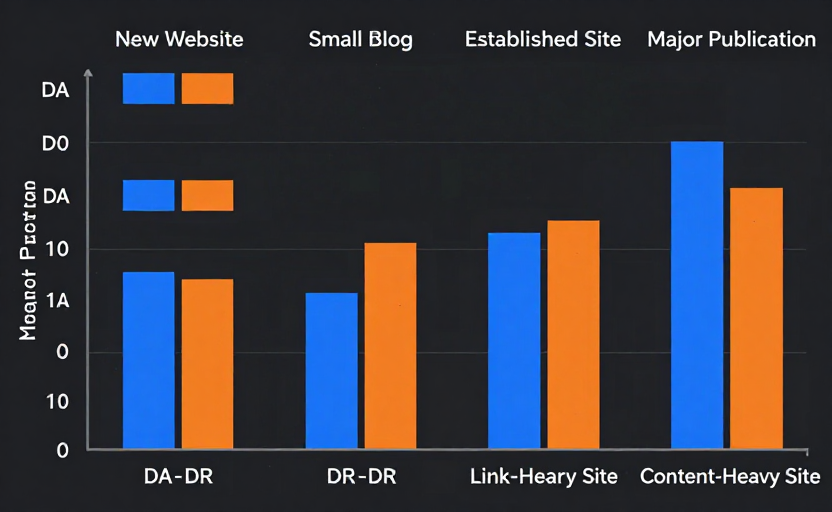
DA vs DR Score Comparison
Here's how DA and DR typically compare for different types of websites:
| Website Type | Typical DA | Typical DR | Notes |
|---|---|---|---|
| New website | 1-10 | 0-5 | DR starts at 0, DA starts at 1 |
| Small blog | 20-30 | 15-25 | DR often slightly lower |
| Established site | 40-50 | 35-45 | Usually within 5-10 points |
| Major publication | 80-95 | 80-95 | Close for very authoritative sites |
| Link-heavy site | 50-60 | 55-70 | DR may be higher (link-focused) |
| Content-heavy, few links | 40-50 | 25-35 | DA may be higher (considers more factors) |
General rule: For most sites, DA and DR are within 10-15 points of each other. Larger discrepancies often indicate a site with unusual characteristics (e.g., lots of links but poor content, or vice versa).
Which Metric Should You Use?
The answer is: use both. Here's when each is more useful:
Use DA when:
- You want an overall prediction of ranking potential
- You're comparing sites in Moz's ecosystem (Moz Pro, Link Explorer)
- You need Spam Score alongside authority metrics
- You're doing competitor analysis across multiple dimensions
Use DR when:
- You want a focused measure of backlink profile strength
- You're using Ahrefs tools (Site Explorer, Content Explorer)
- You want a metric that updates more frequently
- You're focused purely on link building strategy
Use both when:
- You want a complete picture of a domain's authority
- The metrics diverge significantly (investigate why)
- You're making important link building decisions
- You're tracking authority over time
Why You Should Track Both
Tracking both DA and DR gives you several advantages:
- Cross-validation — If both metrics agree, you can be more confident in your assessment
- Divergence detection — If DA and DR diverge, it signals something unusual about the site's link profile or content
- Comprehensive coverage — Moz and Ahrefs have different link indexes; using both covers more of the web
- Tool flexibility — Different SEO tools use different metrics; knowing both lets you work across tools
Other Authority Metrics
DA and DR aren't the only authority metrics:
- Semrush Authority Score (AS) — Semrush's composite metric, similar to DA but using Semrush's data
- Majestic Trust Flow (TF) — Measures the trustworthiness of links pointing to a site
- Majestic Citation Flow (CF) — Measures the quantity of links, regardless of quality
- Domain Power (SE Ranking) — Another composite metric similar to DA
Each has its own strengths and data sources, but DA and DR remain the most widely used and referenced.
Practical Example: Comparing DA and DR
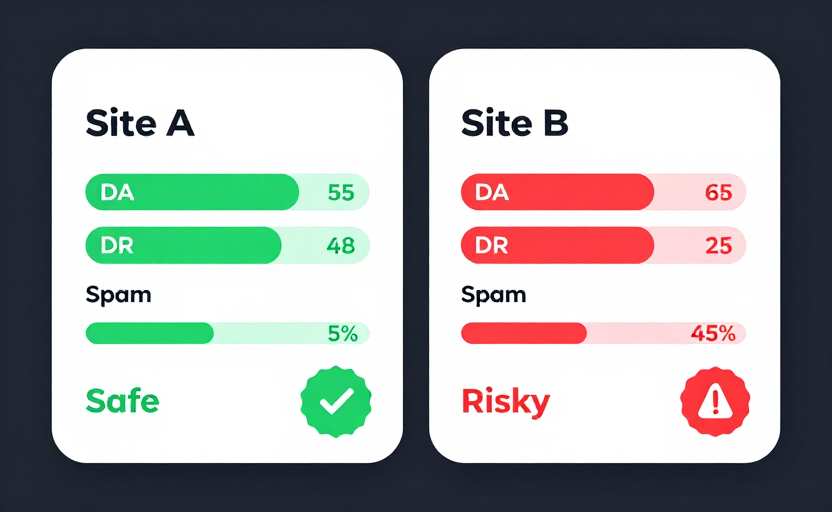
Let's say you're evaluating two potential link targets:
| Site | DA | DR | Spam Score | Recommendation |
|---|---|---|---|---|
| Site A | 55 | 48 | 5% | Good target — consistent metrics, low spam |
| Site B | 65 | 25 | 45% | Risky — DA/DR divergence + high spam suggests manipulation |
Site B has a high DA but low DR and high Spam Score. This divergence suggests the site may have manipulated its DA through questionable link building. The high Spam Score confirms the risk. Site A is the safer and better link target, despite its lower DA.
Conclusion
Domain Authority and Domain Rating are complementary metrics, not competitors. DA gives you a broader prediction of ranking potential, while DR gives you a focused measure of link profile strength. Using both together gives you the most complete picture of a website's authority.
Check both metrics for your site and competitors using our free tools:
- DA PA Checker — Check Domain Authority and Page Authority
- Domain Rating Checker — Check Ahrefs Domain Rating
- Bulk DA PA Checker — Check multiple sites at once
Frequently Asked Questions
What is the difference between Domain Authority and Domain Rating?
DA is Moz's prediction of overall ranking potential using machine learning on multiple link metrics. DR is Ahrefs' measure of backlink profile strength using a PageRank-like algorithm. DA considers more factors; DR focuses purely on links.
Should I use DA or DR?
Use both. DA gives a broader prediction of ranking potential, while DR gives a focused measure of link profile strength. When both metrics agree, you can be more confident in your assessment. When they diverge, investigate why.
Why is my DA higher than my DR?
This often happens with content-heavy sites that have fewer backlinks. DA considers more factors beyond just links, while DR is purely link-focused. A site with good content but a moderate link profile may have higher DA than DR.
Can DA and DR be very different for the same site?
For most sites, DA and DR are within 10-15 points of each other. Larger discrepancies indicate unusual characteristics — such as lots of links but poor content (DR higher) or good content with few links (DA higher).